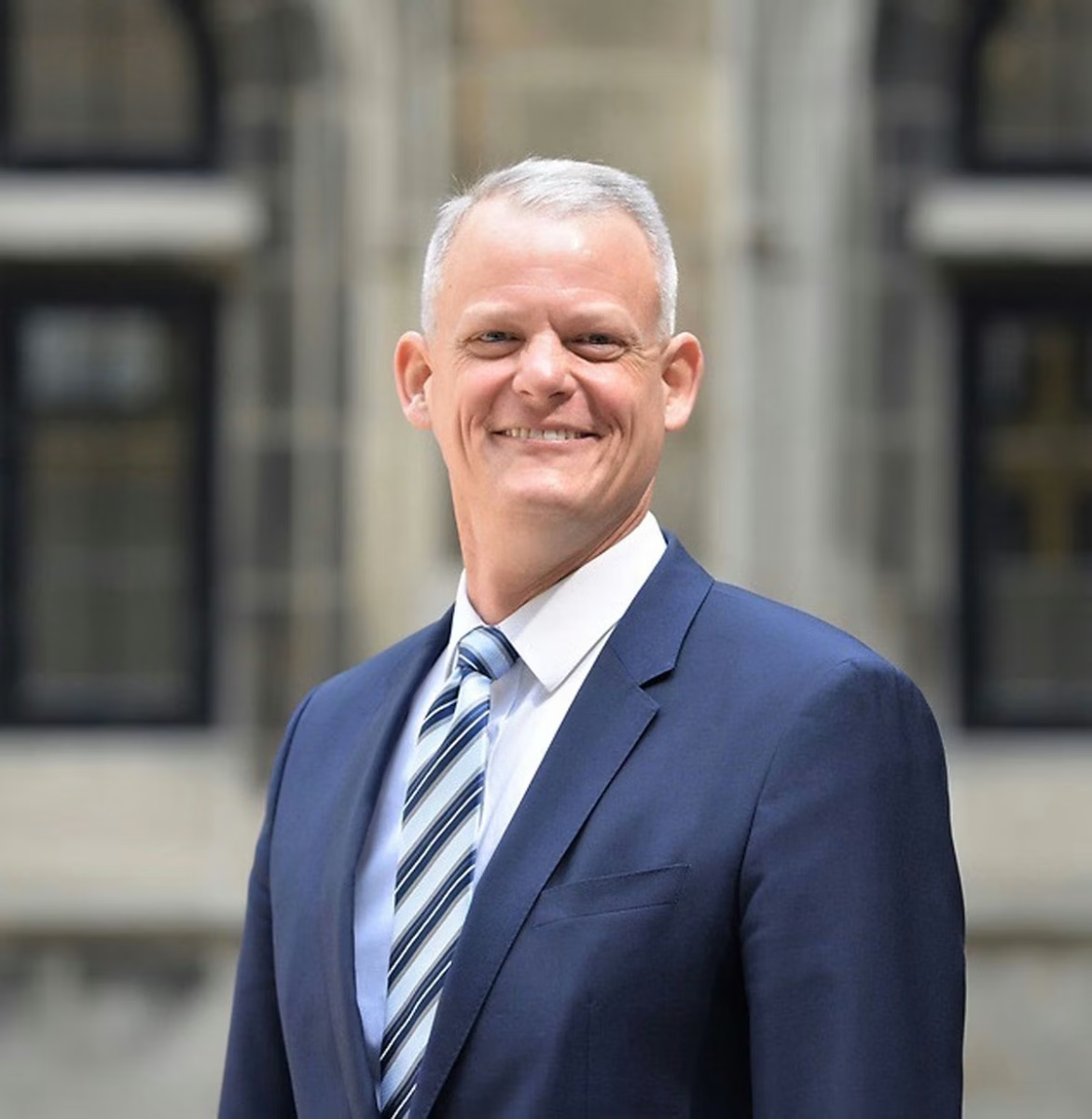
As a high school student at New Trier, I can’t vote yet, but politics affect my life in ways that are hard to ignore. From school safety to gun violence, I can’t help but wonder what kind of future we could be stepping into upon graduation. That’s why I wanted to talk to Phil Andrew, a Democratic candidate running for Congress in Illinois’s 9th district, to understand who he is and what he stands for.

All students who will be 18 prior to November 3rd, 2026, and live in either Wilmette, parts of Northfield, and parts of Glenview, can vote in the primary that occurs on March 17, 2026. Information on how to register to vote is included within the article.
Mr. Andrew grew up in this area, spent over 20 years working as an FBI agent, and was shot in one of the first mass shootings our country has seen right here on the NorthShore as a college student. Throughout our conversation it became clear that his path to public service didn’t start with politics, but where he came from.
Growing up here:
When I asked Mr. Andrew to introduce himself, the first thing he talked about was home. “I’m a local guy,” he told me. He explained that both he and his parents grew up in the district, and he later came back to this area to raise his own family. Listening to him talk made it clear how much this area mattered to him. As someone who’s also growing up in this community, I could relate to that sense of attachment. It’s hard not to care deeply about a place that’s shaped who you are. When I asked Mr. Andrew about his childhood, he talked a lot about our lakefront.“I took advantage of the lakefront a lot,” he said. “I learned to sail and swim, and have been an avid swimmer ever since.” That eventually led to his first jobs. “One of my favorite jobs was lifeguarding on the lakefront,” he said. “I got a lot of responsibility there and I actually saved a life. It gave me a sense of service.” Hearing that made it clear that his idea of service didn’t start in politics or the FBI. But instead with a drive to help others he’d been trusted to protect.
What’s changed since then:
I asked if Mr. Andrew feels different about the community now compared to when he was growing up. He said that some things haven’t changed much like the diversity and the area’s connection to Chicago, but other aspects have changed. “I think one thing that has changed a lot is our sense of security,” he said, pointing to “feeling safe from crime and gun violence” as well as “a sense of security in the world, within our democracy, and with our financial security.” As a student who has grown up with lockdown drills and constant political tension, that answer felt especially relevant.
High school, swimming, and service:
Mr. Andrew went to Loyola Academy, where service played a big role in school culture. “One of the ethos of Loyola Academy was service,” he said. “Their motto is ‘women and men for others,’ and that was very much something that I took to heart.” He also talked about being a swimmer and how athletics shaped the way he thinks about leadership. “I started to recognize those building blocks of what makes a team effective,” he said. “A common mission, accountability, being able to trust each other, but also challenge each other.” For anyone involved in sports, clubs or student leadership at New Trier, those lessons probably sound familiar.
A life-changing experience:
One of the most intense parts of our conversation was when Mr. Andrew talked about the Hubbard Woods School shooting that took place on May 20, 1988. He was in college at the time, captain of his swim team at The University of Illinois, with a bright future ahead. Much of that shattered the day after he returned home for summer vacation after his sophomore year when a school shooter wandered into his home after escaping the school where she opened fire on a class of second graders. She claimed to have been attacked. “After spending 90 minutes trying to calm her down with my folks, I was able to talk her into letting them go. Then, was shot in an attempt to disarm her and was nearly killed,” he said.
He explained that his recovery took weeks and that he was lucky to have survived. What changed his life the most, though, was what happened right before he left the hospital. “The doctor who saved my life sat on my bedside and he asked me what I was going to do about this, and that became my life‘s work.” This is the moment where Phil Andrew knew that something must change. He took a moment that was devastating in so many ways, something that could have squashed his dreams, but he didn’t let it stop him. He emerged stronger than ever.
From advocacy to FBI, to Congress:
After the shooting, Mr. Andrew didn’t step away from life, he leaned into it. “I immediately got involved in advocating for violence prevention,” he said, working on gun violence prevention policies such as requiring background checks and a waiting period for gun purchases. That work led to the passing of the Brady Bill, one of the first major federal gun violence prevention laws. Years later, Mr. Andrew went to law school and “joined the FBI at age 29,” which, “turned into a 21 year career fighting terrorism, public corruption, and serving on hostage negotiation teams.”
When I asked him why he was running for Congress now, Andrew talked about polarization and the threat to democracy we are seeing today. “We’ve recognized just how polarized our country has become,” he said, and how that makes us weak and vulnerable. However, running for Congress, he explained, feels like a continuation of his service. “I feel deeply committed to continue my oath to defend and protect the constitution,” he said.
What students like us can do:
Even though some of our student population at the New Trier can’t vote yet, Mr. Andrew emphasized that young people still have power. “If you are going to turn 18 before the November election, you can actually vote in the primary,” he said, something I didn’t know before this interview. He also encouraged students to get involved in other ways, “volunteering and supporting campaigns…It’s a great way to put energy into the things you care about.” He suggested.
Final thoughts:
As you reflect on Phil Andrew’s story, it’s hard not to notice how often our country slips into an “us vs. them” mindset. We forget that we’re still one community, one nation, all trying to move forward together. Progress doesn’t come from tripping each other up; it comes from listening, learning, and recognizing the value in perspectives different from our own. JFK exemplified this when he said, “Leadership and learning are indispensable to each other.”
Mr. Andrew didn’t sugarcoat the time we’re living in. He called it a crisis, and whether or not you agree with him politically, spending time with him made something clear: the experiences we have like summer jobs, sports, and even moments of trauma can shape who we become and how we choose to lead. His journey is a reminder that engagement doesn’t begin at 18. It begins now, with paying attending, asking questions, and caring about the community you are a part of. For New Trier students, that’s the real takeaway. Leadership isn’t a title you wait for; it’s a habit you build. And learning from one another, especially those different from you, is how we move forward as a school, a community, and as a country.
Find information on how to register, where to vote, and what to bring with you here:
- To register to vote, click here: ova.elections.il.gov (Registration closes on March 1st, 2026)
- To know where you vote, click here: www.cookcountyclerkil.gov/elections/polling-places
- Information on what to bring with you: www.usvotefoundation.org/state-voter-information