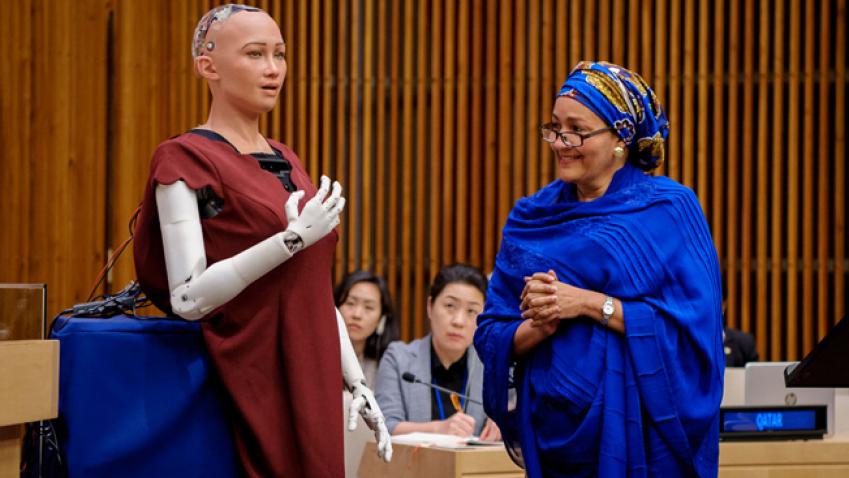
I was first introduced to the controversy over AI legal personhood last year while exploring previous college debate topics. Legal personhood was the focus of the 2021-2022 season, and as I read through past arguments and research, I became immersed in legal jargon and technicalities I knew nothing about yet directly affected my life. This made me genuinely curious about how AI governance frameworks function, as technologies like ChatGPT are increasingly prevalent across all aspects of society. After digging further into my research, I found that this debate has been building for years. In 2017, a humanoid robot named Sophia was announced as an official citizen of Saudi Arabia (Han). More recently, Sophia even spoke in a court case at the United Nations Conference on Sustainable Development, putting her newly acquired legal rights to use (“Humanoid Robot”).
The announcement immediately ignited worldwide controversy; it was the first time that Artificial Intelligence (AI) was granted rights, allowing her to enter contracts and own property, raising questions about its ethical implications and whether similar policies should be adopted in other countries. The United States (US) was no exception to this debate. As AI systems become increasingly autonomous, it becomes harder to determine who is legally responsible for their decisions, since those actions are difficult to track back to any single programmer or user. This complicates liability, leading many to argue that current US regulations are inadequate to address such cases.
In American law, legal personhood designates an entity as a legal person capable of suing, owning property, and entering into contracts. This applies to both humans and non-humans: through landmark cases such as Santa Clara County v. Southern Pacific Railroad Co. (1886) and Citizens United v. Federal Election Commission (2019), the Supreme Court granted corporations legal personhood, allowing groups of people to act together in commerce and litigation (Matthias). Historically, however, legal personhood has been selectively granted, even among humans. Marginalized groups have been denied legal rights through rulings such as the 1857 Dred Scott decision, where all African Americans were not considered citizens and did not have the right to sue in federal court. Similarly, the legal doctrine of coverture denied married women legal personhood throughout the late 19th century by giving their husbands full control over their rights (Matthias). Over time, legal personhood has expanded to all human beings in the US. This expansion paved the path for debates over granting it to non-human entities, such as animals, the environment, and now, AI. Although new regulations are needed to govern emerging AI, granting legal personhood is not the solution the US should adopt. Doing so would risk and introduce further legal ambiguity.
Due to rapid advancements in AI technology, the US is already confronting the limits of its existing legal frameworks. Without a unified regime, companies are left navigating a patchwork of overlapping state and federal rules, while the courts face a growing docket of unprecedented cases. Copyright is one area where these gaps are evident. For instance, the courts are divided on how to apply the doctrine of fair use to Large Language Models (LLMs), a type of AI technology. Fair use allows limited use of copyrighted material without permission from the copyright holder if the courts determine the use is “transformative”, or adds something new to the original. As Judge Chhabria from the District Court for the Northern District of California notes, “Courts have never confronted a technology that is both so transformative yet so potentially dilutive of the market for the underlying works” (qtd. in Levi et al.). Because AI blurs the line between copying and creating, the courts can’t rely on the clear-cut standards set by the Copyright Act, which forces them into uncharted territory. A similar dispute arose when Kris Kashtanova applied for copyright protection for a book illustrated entirely with Midjourney, a generative AI image tool; the Copyright Office initially granted protection before later revoking it, determining that AI-generated images cannot be considered authored works under the Copyright Act (Forrest). These are just two examples of how gaps in the US legal system have bred confusion and even led to ad-hoc rulings. There is no consensus over how to treat AI, leading the courts to flip-flop between what rights it should be afforded, if it should be treated as an independent legal entity, and how pre-existing laws apply.
These Intellectual Property disputes signal a broader problem: the current regulatory regime was not built for what AI is becoming. According to David Arrick, an experienced privacy and emerging technology attorney, “Artificial Intelligence is no longer emerging—it’s entrenched. With the ability to make decisions, execute transactions, and generate legal content at scale and speed, AI systems are evolving faster than the legal frameworks meant to govern them”. Treating AI as just another machine is no longer tenable. As emergent capabilities such as decision-making and generative content make technology more human-like, scholars across the field argue that there is an urgent need for new governance. This is especially true in terms of liability. Emerging technology attorney Katherine Forrest explains that a recently discovered phenomenon called ‘model drift’ makes it extremely difficult to trace the actions of an AI tool back to a human design element, as models can gradually move away from their human-programmed purpose (Forrest). This means that if harm is inflicted, it would be nearly impossible to find a human who is proximately responsible for it. The US is wholly unprepared for such cases, and as they become increasingly common, their outcomes will reach people as close to me as my family. Consider my sister, who works at an AI startup. Her company owns an AI voice-to-text program, and she helps code for the technology that transcribes spoken words while filtering out background noise and filler words. With ‘model drift’, it is possible that the program begins producing inaccurate transcriptions. If someone sues over this error—alleging the program attributed speech to them that they never said—it is unclear if the courts would hold my sister, the company, or the AI itself accountable. No procedure exists for these cases because every precedent relies on the ability to trace the fault back to a human coder. All these examples make it clear that a regulatory change is needed to address what AI is now capable of doing. What they do not establish is that legal personhood is the right path forward.
It makes little sense to grant legal rights and duties to AI because they are incapable of autonomous decision-making. Therefore, they wouldn’t be able to act upon those rights or change their behavior in response to liability. Experts broadly agree that current AI systems are neither sentient nor capable of independent choice, depending solely on the algorithmic code their developers feed them. In an article from the New York Times, Colin Allen, a professor at the University of Pittsburgh studying cognitive skills in animals and machines, writes that, “The dialogue generated by large language models does not provide evidence of the kind of sentience that even very primitive animals likely possess” (qtd. in Metz). Allen argues that what we’ve seen thus far produced by LLMs does not indicate that AI is capable of even the most basic levels of sentience, let alone autonomous decision-making. This is further supported by data-based evidence. Andrzej Proebeski and Jakub Figura, both PhD researchers in machine learning and AI, highlight the stark contrast between the energy demands of AI systems and the efficiency of human minds. Tasks that are considered trivial by humans—such as recognizing faces or interpreting images—require thousands of computations to be replicated by AI (Proebski and Figura). This disparity proves that computational limitations themselves make it technically infeasible for these systems to exhibit biological consciousness. Because AI systems lack the capacity to think for themselves or act in a way outside of what their developer instructs them to, they can’t decide to sue another entity or invoke constitutional protections like due process. That makes it fundamentally illogical to grant them legal personhood, as they would lack the capacity to act upon the majority of the rights bestowed upon them.
The stakes are even higher when considering the broader precedent this would set for liability. Because AI can’t internalize legal or ethical norms or adjust its behavior in response to punishment, some argue that it could be dangerous to hold them accountable for harm. As Yale law professors Ian Aryes and Jack Balkin describe, “Many areas of law, including freedom of speech, copyright, and criminal law, make liability turn on whether the actor who causes harm (or creates a risk of harm) has a certain intention or mens rea”. In the current state of the courts, “intention” is a critical factor in determining liability; by inflicting a more severe punishment on a person who purposefully violates the law, it discourages them from committing a similar act in the future. AI, on the other hand, does not possess “intention.” The implication of holding it liable as an independent entity, AI researcher Jo Baeyaert states, “…could open the door to assigning duties to entities that cannot internalise legal or ethical norms, undermining both deterrence and justice” (369). Because AI does not understand the underlying morals of actions or have autonomous decision-making capacity, the effect of punishment and justice is rendered entirely useless. Baeyaert argues this is dangerous because it could destroy the deterrent effect of the law. Suppose AI causes someone’s death. The system separating different degrees of murder—first-degree, second-degree, and manslaughter—would be inapplicable, because determining which degree should be assigned largely depends on the intent of the convict. The severity of punishment that is inflicted doesn’t matter either because the AI can’t be “discouraged” from committing the same crime in the future. An AI program that is heavily fined is just as likely to repeat its mistake as one that is not fined at all. This makes any legal framework fundamentally hollow, punishing an actor that cannot learn from the past and shifting liability away from people who actually can, absolving those who are responsible.
One of the greatest dangers of AI legal personhood is that it would enable corporations to more easily escape accountability. Previous examples show that big companies will perpetuate unsafe practices and evade responsibility for misconduct whenever it is financially beneficial to them. A recent case involving Tesla illustrates this. After the National Highway Traffic Safety Administration warned the company that its social media posts misled drivers into believing its vehicles were fully autonomous—as drivers still had to keep their hands on the wheel and remain attentive at all times—the company still refused to take them down in hopes of increasing sales (Kolodny). Similarly, when an “autonomous vehicle” crashed in 2019, killing one person and severely injuring another, Tesla sought to have the $234 million jury verdict thrown out, with its lawyers arguing that the self-driving software bore zero responsibility. Some experts in the court case deemed the software as unsafe, yet the company still planned to expand it nationwide in hopes of dominating the new market for driverless taxis (Ewing). The pattern is clear: a company develops potentially dangerous technology, downplays its risks, and later fights to avoid legal consequences when harm inevitably occurs. Had AI legal personhood been in place, Tesla’s path to evade liability would have been even simpler. The company could point to the AI as an independent liable actor, and pay damages using its previously established assets or insurance.
It is not just Tesla that exhibits this pattern, but AI companies broadly. Clearview AI recently gained prevalence after its pioneering technology has allowed law enforcement and government agencies to identify any individual with a single computer search. Its massive database of over 20 billion images from public internet sources makes it the most accurate facial recognition technology to date, but it has raised widespread concern over privacy and the ethics of surveillance. Woodrow Hartzog, a professor of law and computer science at Northeastern University, notes how the US has no federal privacy law, which leaves enforcement up to individual states. Clearview AI has exploited this gap, engaging in the massive collection of personal data, which, if leaked, could cause great harm to people (Perrigo). Once again, this case demonstrates that most large corporations do not prioritize the well-being of their customers and are willing to sacrifice it to advance their business. AI legal personhood would only perpetuate this problem, as companies could now blame the technology, shielding themselves from harsher financial and legal penalties. Despite it seeming far-off, these corporate disputes directly shape how I interact with technology every day. AI-powered tools explain complex calculus concepts to me and help me find articles for debate. Thousands of websites and apps collect my personal data, often without transparency about where it goes. An AI fitness or maps app could silently track my location and sell it to unknown third parties. If legal personhood allows companies to perpetuate such practices with minimal consequence, I am left at a higher risk of harm and with fewer avenues to pursue recourse if something goes wrong.
AI legal personhood would not increase clarity but have the opposite effect, introducing increased ambiguity in the courts by undermining existing legal precedent. Previous grants of personhood in the US—to corporations, for instance—have always been anchored in networks of human accountability. Despite corporations being artificial entities, they remain under the control of shareholders, directors, and officers. These are all humans who can be held responsible on behalf of the corporation through legal and fiduciary obligations. AI, on the other hand, is vastly different, being able to generate outputs unforeseen by even their own developers (Baeyart 356). Imagine one of those diagnostic AI systems used by hospitals, which, after several months of autonomous self-modification on live patient data, begins recommending a new treatment that its original programmers never encoded. If a patient is harmed on this treatment plan, it is unclear who truly bears liability. However, according to current court precedent, it is likely that the programmers would be held responsible, as they are the ones most proximate to the harm. Similarly, in Thaler v. Vidal (2022), the US Federal Circuit Court made a decision reaffirming the principle that “inventorship” can only apply to natural persons. Baeyaert states that, “The judgment reflects a broader judicial consensus: absent moral cognition or subjective awareness, AI lacks the core predicate for agency under law” (369). Introducing AI as a new legal subject would reverse this “core predicate for agency”, forcing courts to re-arbitrate past cases. Would “inventorship” still only apply to natural persons? Who is responsible for the treatment plan? All of these questions would be left unanswered, with no single clear solution, because of the nuance in each example. Despite proponents of AI legal personhood using clarity as a common argument for their case, this proves that it would, in reality, do the opposite. Through generating novel disputes about old cases and forcing courts to revisit core predicates, the effects would cascade: layers of subsequent legislation and precedent built on top of these “old predicates” would equally be subject to re-examination, causing legal upheaval.
Those who advocate for AI legal personhood often argue that the complexity and scale of modern AI systems make existing laws too limited to manage them. Although this concern is valid, targeted solutions are available within current regulatory frameworks that can address the issue without the risks associated with personhood. For example, legal scholars Ian Ayres and Jack Balkin have proposed an “Ascribed Intentions and Objective Standards” framework, which would hold humans and companies behind AI systems to an objective standard of reasonableness. This means that liability determinations would be flexible and spread out, but ultimately, focused on human actors. AI would only be considered in relation to the people who design, use, and propagate the technology. Different individuals involved in an incident would share damages proportionally, with evidence used to assess each actor’s contribution to the harm (Ayres and Balkin). If unexpected results arise that are impossible to trace back, no single person would be punished for that specific part of the case. Baeyaert further endorses this model, calling it “relational personhood.” He says, “Courts applying this model would be less concerned with whether the AI ‘acted intentionally’ and more focused on how its outputs interacted with human judgment and regulatory compliance” (370). By shifting the focus to how humans interact with AI rather than on AI itself, this approach removes many of the indeterminable questions that complicate court rulings today. Instead of asking if an AI intended harm—a question current science can’t answer—courts should anchor accountability where precedent exists: with human actors.
The governance of AI is one of the most pressing policy challenges of our era, but urgency is not an excuse for impulsiveness. Granting AI legal personhood would upend liability law and overturn long-standing court precedent, which carries serious and lasting consequences. Historically, the US has only extended personhood where it is rooted in humanity. AI’s potentially untraceable nature challenges that foundation entirely, raising questions about who—or what—deserves rights, and on what basis we grant them.
My generation will inherit the framework that lawmakers decide on now. AI is an inescapable part of daily life, and how we regulate it is a test of competing values: accountability, innovation, justice, and more. Despite legal personhood seeming like a clean solution to complex questions of liability, it is deceptive. Corporations have proven time and again that they will use whatever means they can to escape accountability, and personhood would just be another legal shield that they can hide behind. Ultimately, AI was created by people, deployed by people, and weaponized by people; accountability must reflect that reality. I fear that anything else will sacrifice safety and justice for the illusion of a solution.
Works Cited
Arrick, David. “AI’s Leaps Forward Force Talks about Legal Personhood for Tech.” Bloomberg Law, 28 May 2025, news.bloomberglaw.com/us-law-week/ais-leaps-forward-force-talks-about-legal-personhood-for-tech. Accessed 23 Mar. 2026.
Ayres, Ian, and Jack M. Balkin. “The Law of AI Is the Law of Risky Agents without Intentions.” The University of Chicago Law Review, 27 Nov. 2024, lawreview.uchicago.edu/online-archive/law-ai-law-risky-agents-without-intentions. Accessed 11 Mar. 2026.
Baeyaert, Joffrey. “Beyond Personhood.” Technology and Regulation, vol. 2025, 8 Sept. 2025, pp. 355-86, https://doi.org/10.71265/ssvg8a97. Accessed 24 Mar. 2026.
Ewing, Jack. “Tesla’s Lawyers File Motion to Throw out $243 Million Verdict in Fatal Crash.” New York Times, 29 Aug. 2025, www.nytimes.com/2025/08/29/business/tesla-fatal-crash.html. Accessed 5 Feb. 2026.
Forrest, Katherine B. “The Ethics and Challenges of Legal Personhood for AI.” The Yale Law Journal, vol. 133, 22 Apr. 2024, yalelawjournal.org/forum/the-ethics-and-challenges-of-legal-personhood-for-ai. Accessed 5 Feb. 2026.
Han, Lichen. “The Emerging Question of AI Legal Personhood Asked of Us by the Likes of Google Duplex and Sophia.” Science and Technology Law Review, 17 Oct. 2018. Columbia University Libraries, journals.library.columbia.edu/index.php/stlr/blog/view/134. Accessed 17 Feb. 2026.
“Humanoid Robot Joins UN Meeting on Artificial Intelligence, Sustainable Development.” United Nations, www.un.org/en/desa/un-robot-sophia-joins-meeting-artificial-intelligence-and-sustainable-development. Accessed 26 Mar. 2026.
Kolodny, Lora. “Tesla Must Pay Portion of $329 Million in Damages after Fatal Autopilot Crash, Jury Says.” CNBC, 1 Aug. 2025, www.cnbc.com/2025/08/01/tesla-must-pay-329-million-in-damages-in-fatal-autopilot-case.html. Accessed 5 Feb. 2026.
Levi, Stuart D., et al. “Fair Use and AI Training: Two Recent Decisions Highlight the Complexity of This Issue.” Skadden, 8 July 2025, www.skadden.com/insights/publications/2025/07/fair-use-and-ai-training. Accessed 23 Mar. 2026.
Matthias, Meg. “Legal Personhood.” Encyclopedia Britannica, 11 Dec. 2024, www.britannica.com/topic/legal-personhood. Accessed 23 Mar. 2026.
Metz, Cade. “A.I. Is Not Sentient. Why Do People Say It Is?” The New York Times, 5 Aug. 2022, www.nytimes.com/2022/08/05/technology/ai-sentient-google.html. Accessed 23 Mar. 2026.
Perrigo, Billy. “An AI Company Scraped Billions of Photos for Facial Recognition. Regulators Can’t Stop It.” TIME, 27 May 2022, time.com/6182177/clearview-ai-regulators-uk/. Accessed 5 Feb. 2026.
Porębski, Andrzej, and Jakub Figura. “There Is No Such Thing as Conscious Artificial Intelligence.” Humanities and Social Sciences Communications, vol. 12, no. 1, 28 Oct. 2025, https://doi.org/10.1057/s41599-025-05868-8. Accessed 24 Mar. 2026.